
Rethinking the Economics degree: The IIM Bangalore approach

1. The Idea of an Economics Degree
For decades, an undergraduate Economics degree has followed a fairly familiar structure: Microeconomics, Macroeconomics, Mathematics, Statistics, Econometrics, Development Economics and more.
The objective is simple: understand how economies work, and learn to analyse them.
But what happens when that degree is designed not by a traditional Economics department, but by a management school?
2. Enter IIM Bangalore
This is what makes IIM Bangalore’s undergraduate Economics programme interesting.
It isn't simply Economics with a few management electives. Alongside Economics, students encounter Data Science, Business, Communication, Ethics and Humanities, and experiential learning.
The difference isn't about which model is better. It is about what each model believes an undergraduate should become.
3. From a “Discipline” to a “Problem-Solving Toolkit”
A traditional Economics degree is discipline-centred. You study Economics to understand Economics.
IIMB’s approach moves towards something more application-centred: Economics becomes part of a broader analytical toolkit.
Economics teaches incentives and behaviour. Statistics teaches us to reason from evidence. Data Science helps us work with data. Business provides context. Communication helps articulate conclusions, while Ethics and Humanities make us consider their consequences.
The student is therefore encouraged to look at a problem from multiple dimensions.
4. Why Does Data Science Belong Inside an Economics Degree?
Economic analysis has always relied on data. But increasingly, the journey is moving from Theory → Data → Econometrics → Causal Inference → Decision.
Data is no longer something economists simply consume. It is something they need to interrogate.
Understanding large datasets, identifying patterns and distinguishing correlation from causation can fundamentally change how economic questions are approached.
5. Why Does Business Belong Inside an Economics Degree?
A traditional Economics department might ask: Why do firms behave the way they do?
A management school can ask an additional question: What should a firm do about it?
Economics brings markets, incentives and competition. Business adds strategy, organisations, operations and decisions.
The two aren't competing disciplines. They are different lenses on the same problem.
6. The Bigger Shift: From Specialisation to Multidisciplinarity
Real-world problems rarely fit neatly into academic departments.
Consider urban congestion. It involves economics, data science, public policy, psychology, business and ethics.
The world is interdisciplinary, even when universities aren't.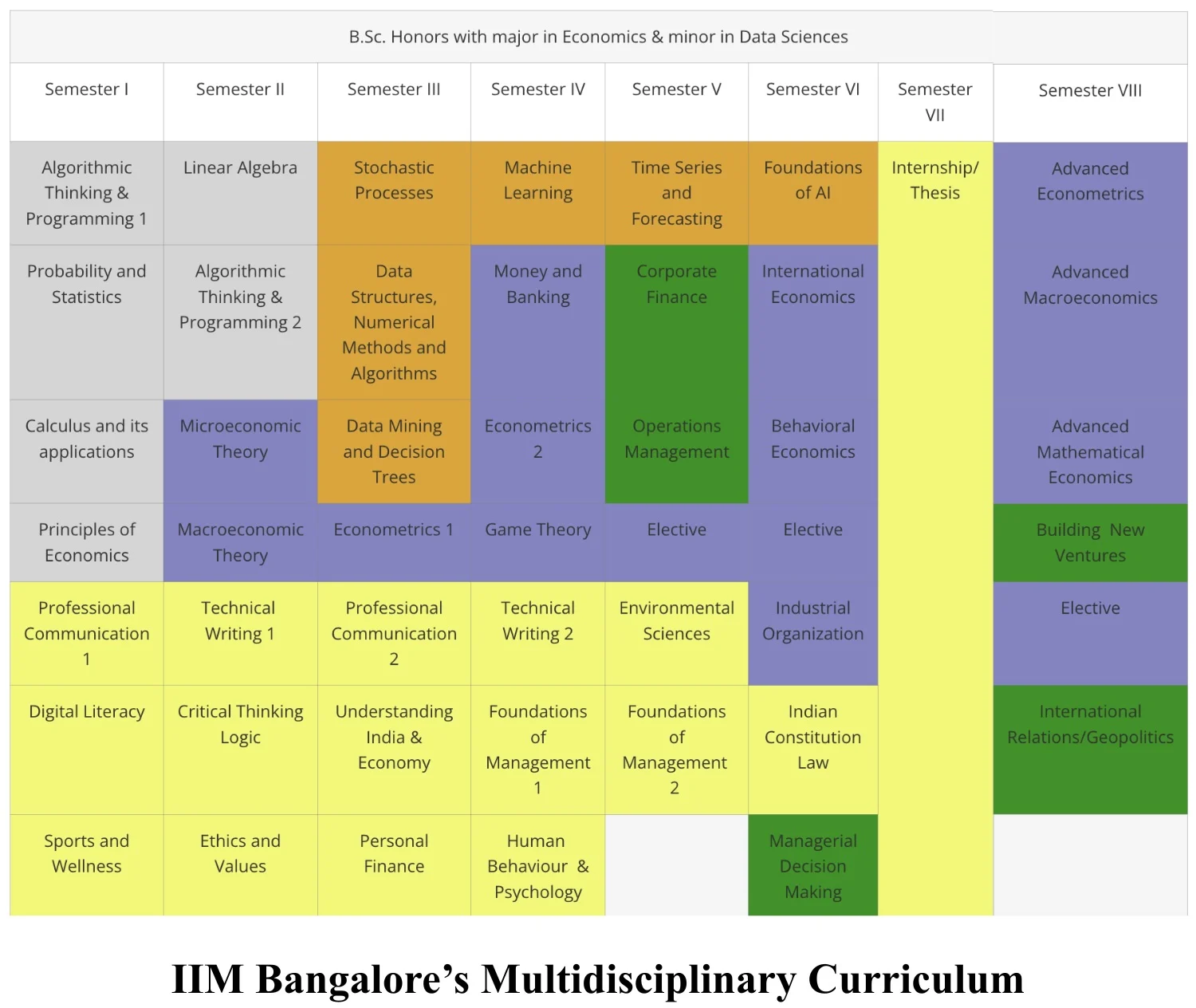
7. But Is Multidisciplinary Automatically Better?
Not necessarily.
Breadth offers adaptability and multiple perspectives. Depth offers mastery, theoretical sophistication and stronger foundations.
The question isn't whether breadth is better than depth. It is what balance a particular student needs.
8. So Who Is the IIMB Economics Degree Actually For?
Perhaps it is for the student who thinks:
“I like Economics, but I don't want Economics to be the only thing I study.”
A student interested in Economics, data, business, technology, policy and problem-solving may find this model compelling.
Someone seeking a purely disciplinary Economics education may find a traditional Economics Honours programme more aligned with their interests.
IIMB isn't necessarily replacing the traditional Economics degree. It is proposing another version of what an Economics degree can be.
9. The Larger Question
Perhaps the question is no longer “What should an Economics student study?”
It is: “What should an Economics graduate be capable of doing?”
The answer seems to be changing. Economics may increasingly become one component of a larger toolkit for understanding complex problems.
IIM Bangalore’s undergraduate programme is an interesting experiment in that direction. Whether this model becomes the future of undergraduate education remains to be seen. But the question it raises is already worth asking.